Your Resilience story: Making parent and carer voices for young people heard
A four-session programme has delivered impact in supporting parents and carers to build confidence, skills and resilience to support young people’s wellbeing.
Young people’s mental health is part of national conversations. Politicians, schools and health and social care providers are working to respond to growing demands. The people who are shouting loudest about it, however, are parents and carers.
Across Scotland, many speak about stress, anxiety and pressure in their children’s lives. They talk about friendships, peer pressures, social media and exam demands. Yet, many parents feel ill-equipped to support their children with these challenges and few know where to turn for guidance.
While programmes exist to support young people directly, structured and accessible education for the adults around them has been harder to find. Research shows that parental engagement improves outcomes, yet parents are rarely involved in resilience and wellbeing programmes designed for schools.
To address this, we our Young People’s Programmes have developed ‘Your Resilience for Parents and Carers’ in partnership with CAMHS Tayside. The four-session programme offers parents a deeper understanding of resilience, practical tools to support their children’s wellbeing and the confidence to have open conversations at home.
Your Resilience for parents and carers in schools and communities
Following a successful online pilot in 2024, the programme was rolled out directly to school communities in 2026. Three groups took part: the Parent Council of Waid Academy in Fife, a parents’ group at Holyrood Secondary in Glasgow and families connected across four schools in East Kilbride through the ‘Take Time Families’ initiative.
Before the programme began, parents were asked how confident they felt about supporting their child’s resilience. Confidence varied widely. Some described themselves as somewhat confident. Others were neutral or unsure. For many, resilience was understood simply as “bouncing back” or “strength”. Few had considered it as something that could be actively developed.
Many parents attending were already facing complexity. A significant number were supporting neurodivergent young people or children with existing mental health diagnoses. They came with lived experience and a consistent hope for guidance. When asked what they wanted to gain, they said:
“A better understanding and tools to support my child’s mental health and resilience.” – Parent, Holyrood Secondary School
“I want to find a reason to believe my child will become a better person eventually.” – Parent, St Andrew’s and St Bride’s High School
“To feel more confident in speaking to my children about resilience and their own mental health.” – Parent, Waid Academy
“To be able to have the tools and confidence to help my child when they are struggling, that I would not second-guess myself, worrying I was saying or doing the wrong thing.” – Parent, Holyrood Secondary School
measurable impact and change
The programme was delivered across four one-hour workshops. Each session is built on the previous one: understanding resilience, coping with stress, managing friendships and social pressures, and having conversations about mental health while looking after your own resilience.
Clarifying what resilience really means was a critical part of the workshops and informed how parents approached later sessions.
The discussion around friendships and social pressures was especially spirited. Parents spoke about social media, peer dynamics and the difficulty of knowing when to intervene. There was reassurance in realising that others were asking the same questions.
The final session, which focused on mental health conversations, prompted some of the most meaningful reflections. Several parents said they had never been given a clear framework for these discussions before. One described gaining “a very usable toolkit and practical strategies,” while another reflected that they felt a “greater confidence in the ability to support the child in building resilience.”
As one parent shared, “It has been very useful to hear other parents’ experiences and this last week my daughter has opened up more to me.” Others were clear about the impact: “The course was brilliant. So informative.”
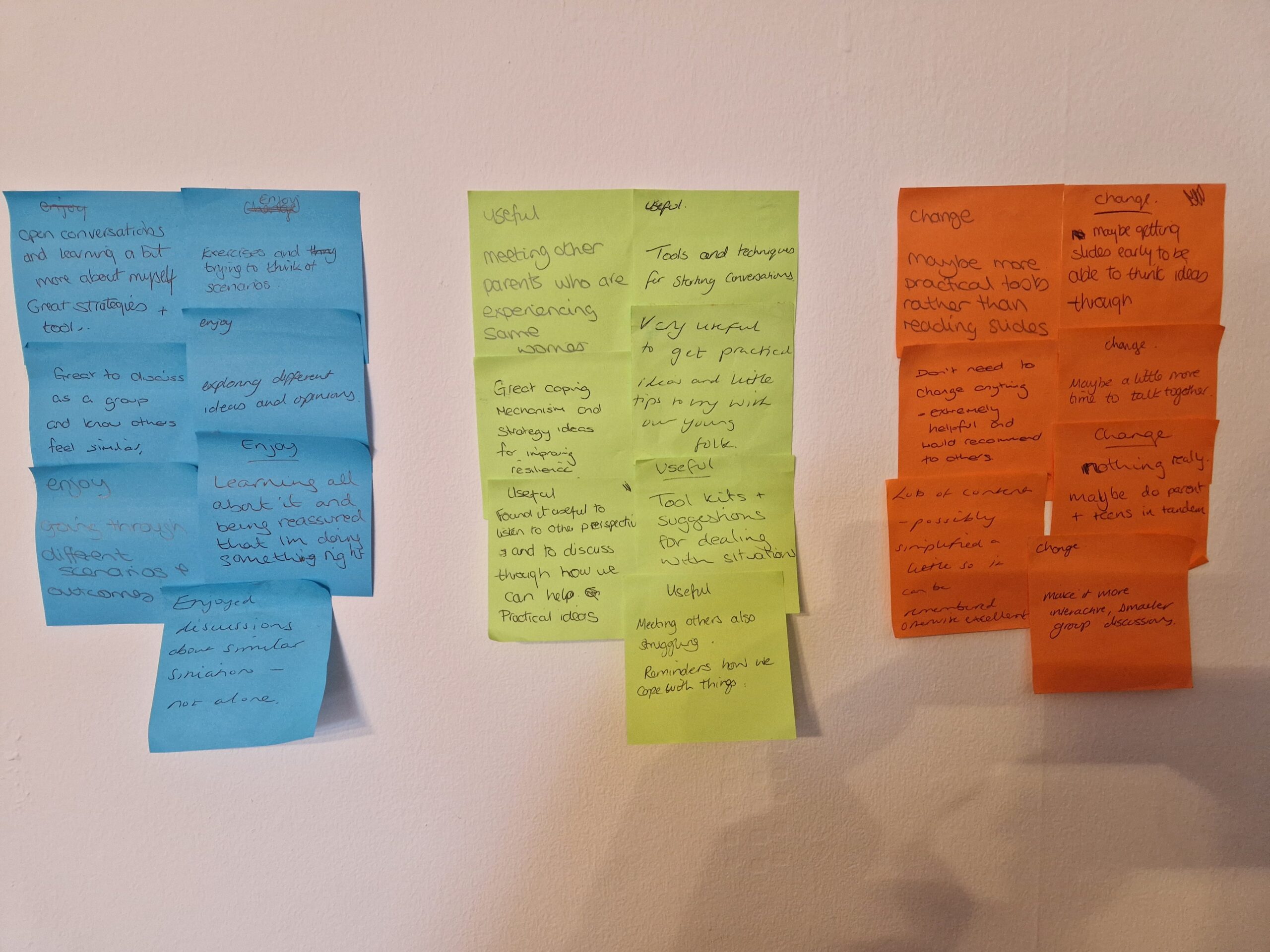
By the end:
- The understanding of resilience deepened. For participants, it became less about toughness and more about the ability to adapt, grow and develop tools to navigate future challenges.
- 89% of respondents felt confident or very confident in their own resilience and coping skills.
- 88% felt confident in their ability to support their child’s mental wellbeing, compared to 46% at baseline.
- 93% felt confident discussing resilience and mental health at home.
what we’ve learned from parents and carers
This programme confirmed the scale of need among parents, particularly those supporting neurodivergent young people. Many were seeking guidance that reflected their specific circumstances. In response, the same initiative is now working with the National Autistic Society to review and adapt materials to make them more inclusive and directly useful.
There was a clear appetite for discussion. Sessions often ran over because parents wanted space to talk and reflect. Future delivery will explore extending sessions or offering additional materials to allow that space.
Access also mattered. Delivering through schools and community groups reduced barriers and widened reach. It highlighted the importance of engaging in a more diverse group of parents. To date, most participants have been women. Future delivery will seek to involve more fathers and male carers.
By supporting parents and carers, we are helping them feel more confident, less alone and better equipped to respond to what their children are facing. In doing so, we are putting children first.
The next challenge is scaling delivery while remaining responsive to the diverse and sometimes complex realities of family life. The foundation is there to build on it with feedback in mind to be actioned carefully and thoughtfully.
contact
Want to find out more about young people’s mental health resilience and the support we deliver to schools, colleges and youth centres across Scotland?
If you need further information about Young People’s Programmes or want to enquire about online training, resources or how we can help your school or college, contact our team.
Do you have any more questions about the support Change Mental Health delivers across communities in Scotland? Contact our Advice and Support Service.
