Daz’s story: The Wednesday that gets him out of the house
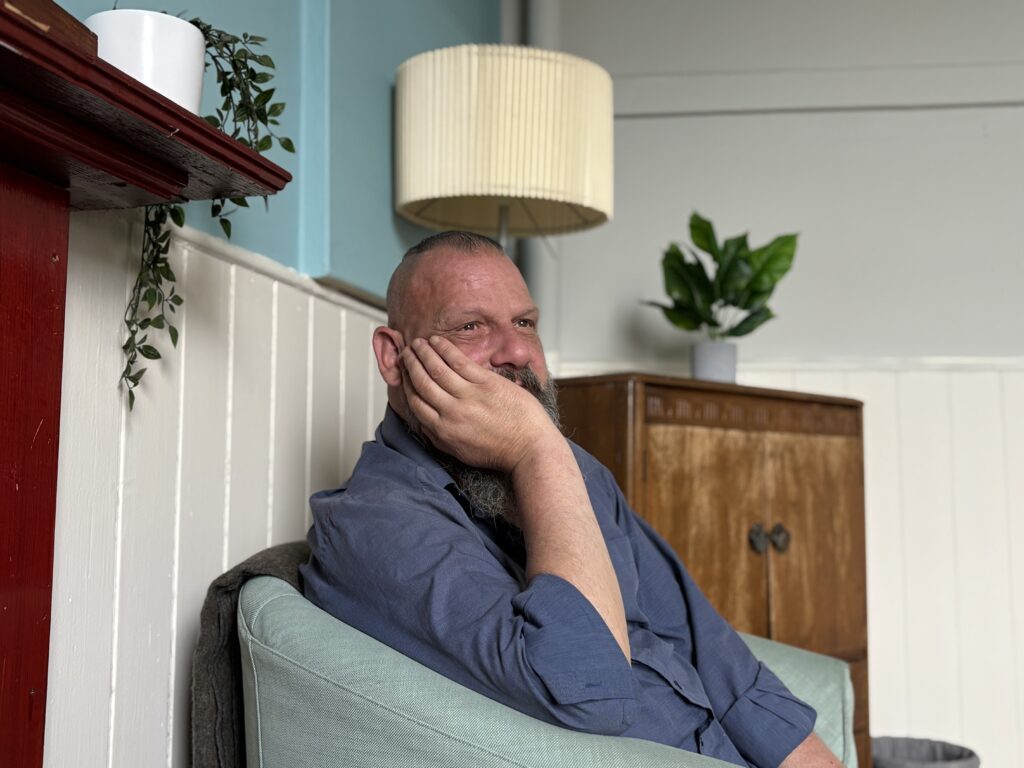
My curtains stay closed. The only time I look out is when the seagulls chap on the window. That’s how I know it’s morning.
I joined the army at 17. My childhood made it a natural progression. My father was a sadistic, cruel man who believed suffering would make me hard. He wasn’t wrong about the hard part. So, when the Cold War needed soldiers and I needed out, I signed up.
What I didn’t know was that I was already carrying things I wouldn’t have words for until my sixties: Post-Traumatic Stress Disorder (PTSD), ADHD, Obsessive Compulsive Disorder (OCD), probably autism. 23 years in the British Army with all of that running underneath. You might feel things are out of kilter. Something is not quite right. But it’s everybody else that sees it. They don’t tell you.
I did a lot of good stuff. Bosnia. Northern Ireland. 1999 was the best year of my life: Brunei, best student on the Jungle Warfare Instructors course, then Brecon, best student on the sniper instructors course, then six months in Belize. I’ll never forget it. But you can be a very troubled person and be good at what you do in the infantry. There’s just no off switch. And that’s the problem.
In 2009, my service was up and everything went with it. It was just, ‘yeah, cheers, easy, bye’. That’s what it felt like. The structure, the purpose, the people, gone. I ended up in Doncaster for my stepson who needed specialist care, spending seven months trying to find work. I hated it. My relationship was falling apart in ways I hadn’t seen coming because I’d been too busy providing for my family.
I tried to hold it together for as long as I possibly could. I did odd jobs:security, construction, taxi driver. I ended up north trying to reconnect with my father, then in a relationship that collapsed badly and left me in very dangerous circumstances. By 2019, I was in Edinburgh after a serious nervous breakdown.
Finding the Veterans Community Café in Edinburgh
Somebody mentioned the Veterans Community Café. I knew some of the members from before, so I went. The very first day I came in, I felt welcome. I haven’t turned back since.
I want to be clear about what that means, because it’s not what people might expect. There are no treatment plans. Nobody takes you aside and says, “Right, tell me how you’re doing?” Nobody asks you to fill in a form about your mental health every single Wednesday. Because if I thought for one second I was going to get grilled about my health, about what I’ve been through, about any of it, I wouldn’t come. If you’re taking that long just to get yourself to a point where you can function, the last thing you want is someone reminding you of it the moment you walk through the door.
That’s what I didn’t understand about the veterans community for a long time. Sometimes it can be too much. Too much shared weight in the room. Too many people who’ve been through it, pulling at the edges of things that are better left alone that day. The café isn’t like that.
We joke around. We talk about football. I hate football, but I’m quite happy to listen to them and have a good chinwag about it because they’re connected to it, and that’s good to see. Every now and again, someone says something deeper and we all feel it in some way none of us can quite explain.
I’ve got a lot of cancer. My pancreas is gone. My arthritis does my head in. My hip keeps coming out. It took me a long time to tell the rest of the members, because they’d had their own health battles, and I just couldn’t bring myself to add mine to the pile. And then my brother Mark, up north, lost his leg to sepsis and half his pelvis. We’re all dying, you know what I mean? I’m happy. I have no regrets. I just want to make sure Mark’s okay. If he’s okay, I’m okay.
Saying it to them was a bit of a weight off my shoulders. I’d been holding on to that for a while.
What ‘connection’ means
What the café gives me is connection. And I don’t mean that as an abstraction. I mean: the pharmacy for my meds, the shop for food and the café on a Wednesday. That’s it. Those are the reasons I leave the house. Otherwise, I don’t come out. My curtains stay closed. The seagulls chap on the window sometimes. That’s how I know it’s morning.
I look forward to Wednesday. There are guys here who are desperately lonely, you can see it clearly. We don’t talk about it. We get them laughing. We talk about something stupid. But I can see the impact it’s having on them, just being in a room where nobody’s going to judge them or push them to divulge anything. I’ve been alone all my life. Even when I’ve been with people, I’ve been alone. I’m okay with it in a way some of them aren’t yet.
But once I’m here, I feel safe.
A note for veterans living with PTSD and mental health conditions
The thing about mental health, as a label, as something named on a sign or a leaflet, is that for a lot of us who’ve spent years not naming what we’re carrying. It can be a reason not to walk through the door at all. Not because we’re ashamed, but because it took so long to get to a place where you can function and you don’t want to risk going back. People go too far back in without appropriate support and they take their lives.
There are a lot of us in that cave with curtains closed. And if you’re one of them, hear this: we’re not fine. But Veterans Community Cafe isn’t what you think it is. Nobody’s waiting for you with a clipboard and a questionnaire. It’s just: all right, you’re here. Well done. Have a cup of coffee and let’s chat.
That’s it. That’s enough.
support
Daz has been attending the Veterans Community Café since 2019. The café runs every Wednesday and Friday and is open to all veterans. It is hosted by Change Mental Health at its Stafford Centre service in Edinburgh. The initiative is funded by the Veterans Foundation.
If you have any questions about the Veterans Community Café, please contact Joe Sangster (Veterans Café Coordinator). You can find out more about the support we deliver in Edinburgh here or call on 0131 608 6389 to speak to our team.
Our National Advice and Support Service can help you and people you care for with mental health concerns and money worries.
We can link and signpost you to relevant local and national support, including our own Change Mental Health services, as well supporting with debt, grants and benefits.
The service is open Monday to Friday, 10am to 4pm (closed for lunch between 12.30pm to 1.30pm). Contact 0808 8010 515, email advice@changemh.org or fill in the form on the service webpage.
For full details about the service, visit the National Advice and Support Service webpage.
