Carers’ bingo: on being a dad, an unpaid carer and asking for help
Jonny, Director of Development at Change Mental Health, reflects on being a dad, a leader and an unpaid carer – and how recognising all three changed everything.

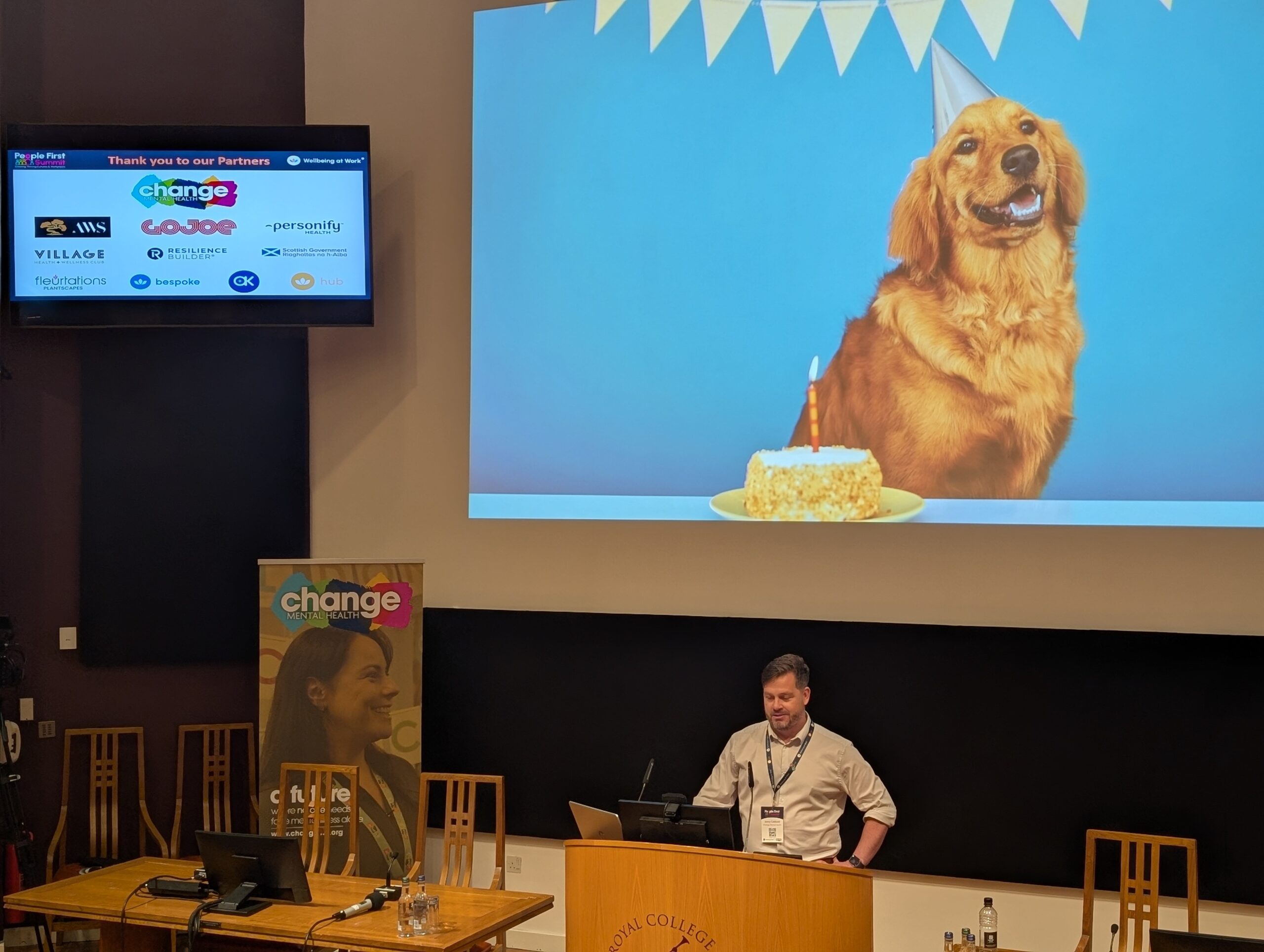
I was invited to speak at the Supporting Mentally Healthy Workplaces National Employer Event, run by Public Health Scotland as part of their Mentally Flourishing Workplaces Framework. They asked me to talk as both a leader and an unpaid carer – which is funny, because it took me an embarrassingly long time to realise the second part, let alone say it out loud. Especially given I’ve spent the best part of a decade working in organisations that support carers. It turns out the obvious things are sometimes the hardest to spot in your own life.
I’ll start with a little bit of background. After many years of trying to start a family, my wife and I were lucky to have a little boy (now aged 9) and then two little girls (aged 7 and 5). They’re the most amazing kids and we feel like the luckiest parents in the world.
They’re hilarious, stubborn, kind, and full of joy – and they’re competing to see who can have the most complex medical conditions. My eldest is tube-fed overnight, which means most nights I’m up four or five times to fix his pump, and my older daughter has a genetic condition called Fragile X. And my youngest one is about to start genetic testing for a range of syndromes the doctors think might explain the breathing difficulties she’s had since birth, which means my wife and I may be about to complete our very own game of carers‘ bingo.

What good support for carers actually looks like
When Public Health Scotland asked what reasonable adjustments have helped most, my honest answer is simple: the biggest one Change Mental Health ever made was hiring me in the first place. They did that knowing my caring responsibilities were complex and ever-changing and that I live in England while the organisation is based in Scotland. What followed was joining an incredible team, doing work I care deeply about, with people who genuinely support me. I’ve even fallen in love with Scotland.
On a purely logistical level, working from home most of the week has been transformative. I can work right up until 5pm and collect the kids at 5.05pm. I can do most of the school drop-offs and still be at my desk by 9am. Getting up to Scotland regularly – about once a fortnight – still really matters. This way of working lets me be a good colleague, manager and leader while also being a good dad, carer and husband. And while Mrs Cobbold might not entirely agree, a night away in Edinburgh every other week isn’t the worst thing in the world!
But the adjustment that matters most isn’t really a policy at all. Policies are essential, but they only work alongside culture and relationships built on trust, openness and empathy.
For me, the magic is in the balance between high expectations and high support. Being a carer isn’t an excuse – I still want to do a really good job and I want my colleagues to expect that of me.
But those expectations have to sit alongside genuine flexibility and empathy: being able to attend last-minute appointments and never feeling self-conscious about taking A to the dietician or E to the genetics team. My colleagues at Change Mental Health understand, often without even saying a word.
Caring can be a rollercoaster. With our circumstances you never quite know when the next curveball is coming. But I always feel supported, on a really human level, and that more than any single policy, is what protects my wellbeing.
Why relationships matter more than policies
As a leader, creating an environment where people feel able to seek support starts with relationships. We spend roughly half our waking hours at work, so it matters enormously that we build meaningful connections with the people we share that time with. That doesn’t mean we have to be friends (though we can be). It certainly doesn’t mean we’re ‘family’. I’ll be honest, that one always makes me wince. But it does mean taking the time to know our colleagues as people – the person behind the job title.

And we can all lead by example here, whatever our role. Ask how someone’s weekend was and actually listen. Learn the names of your colleagues’ kids. When someone mentions their mum hasn’t been well, remember to ask how she’s getting on and how they’re feeling about it.
As Maya Angelou said: “I’ve learned that people will forget what you said, people will forget what you did, but people will never forget how you made them feel.” It’s a famous line and it’s worth repeating.
If you’re struggling but not sure why
If I’m talking to someone whose mental health is being affected but who feels hesitant to say so, the first thing I’d share is this: the single most powerful thing for me wasn’t a policy or an adjustment. It was simply realising that I was an unpaid carer.
Despite working in health and social care for many years, it took a ridiculously long time to get it through my own thick skull. But when it finally did, it was a paradigm shift in how I thought about my life and the support I might actually need. It made me realise that, even though it’s all completely normal to me, not everyone connects their nine-year-old to a feeding tube each evening and gets up four or five times a night to fix the pump. Not everyone has a daughter who needs to be collected at 5pm on the dot, because waiting until 5.20pm means hours of tears and big emotions.
If there’s one thing I’d offer anyone whose wellbeing is being affected but who feels hesitant to say so, it’s this: take a moment to reflect on how you’re feeling and on what support might help. Recognising when you need a bit of extra help and then going and getting it is not a sign of weakness. Seeking support to help you stay well or get well could make you a better parent, partner, carer or colleague.
It took me long enough to learn that, and I paid the price with burnout, poor mental health and some unhealthy coping strategies. I’d love it if other people saved themselves on that particular journey.
support
If you’re an unpaid carer, support is available – and you’re allowed to need it.
Unpaid carers play a crucial role in supporting the people they love, often at significant personal cost, and often without ever recognising themselves as carers at all. If that sounds familiar, you’re not alone.
Change Mental Health’s Carer Support services offer emotional support, practical advice, advocacy and help navigating the health and social care systems. The National Advice and Support Service can provide information on carers’ rights, benefits and signposting to support across Scotland.
The service is open Monday to Friday, 10am to 4pm (closed for lunch between 12.30pm to 1.30pm). Contact 0808 8010 515, email advice@changemh.orgor fill in the form on the service webpage.