
Marcy’s story: Making space to talk about voices
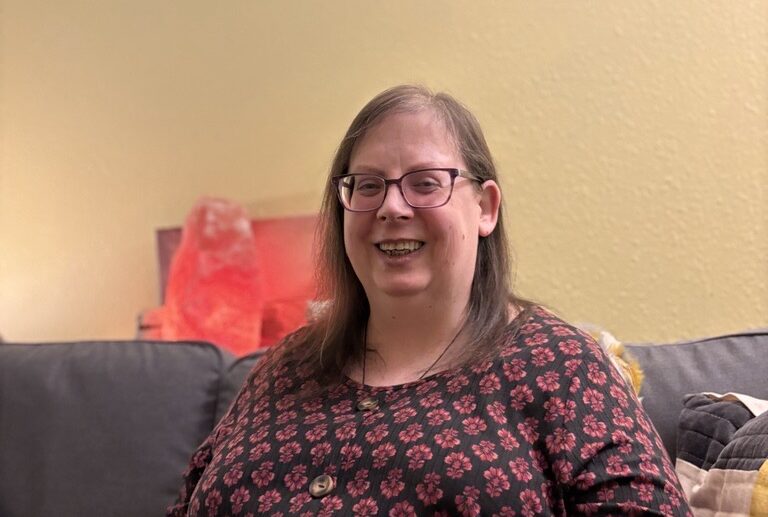
Marcy has lived with mental health challenges since her teens. She had signs of a mood disorder since she was 13. She experienced periods of intense focus and energy — immersing herself in learning, entering competitions and throwing herself into music. At the time, this was seen as enthusiasm and talent. However, what wasn’t visible were the moments she spent crying on her best friend’s bathroom floor, wondering why her chest hurt though it had been ripped open.
Voices came later. Marcy began hearing voices at 19. Support at that time focused mainly on medication and managing periods of mania and depression, often through hospital admissions. There was little space to talk about what the voices meant or how they shaped her daily life.
Some of them have names. Lydia and Ryan are among the most prominent. Alongside them, she also hears a chorus of voices – sometimes mumbling, sometimes speaking to each other, and at times crying or wailing. They respond to what’s happening around all of us: a messy house, a crowded bus, a long queue in the pharmacy. At times they are overwhelming and distressing; at other times, they are simply there.
There is no day when she does not wish the voices were gone. But they are part of her reality, whether spoken about or not.
“I’ve had voices for years. People talk about them like they’re all the same but they’re not. They’re different and they affect you in different ways. Lydia is nasty, cruel and very negative. Ryan has the voice of a young boy and he very often cheers me on, congratulating me when I’m doing well.”
Diagnosis was not straightforward. Marcy was first told she had bipolar, then later it was changed to schizoaffective disorder. In both cases, she learned that speaking openly about voices often led to fear or misunderstanding. This means that she stopped talking about them, particularly in clinical settings where conversations focused on diagnosis and risk rather than lived experience.
reaching out for support
Hospital admissions have been a recurring part of Marcy’s life, particularly during depressive episodes when she experienced suicidal thoughts and was at risk of self-harm. During one of these admissions, Marcy self-referred to Change Mental Health’s Hearing Voices service in Tayside. She was looking for something to help her stay well after discharge. Hearing Voices felt different from anything she had tried before, particularly because of its focus on peer support.
Initial support began over the phone. From the first conversations, Marcy felt at ease with Terry, an Outreach Worker with the service.
Marcy said:
“I hit it off with her straight away. I didn’t feel judged or like I had to explain myself. It felt easy to talk. I could just say things as they were without worrying about how it would be taken.”
Rather than trying to eliminate or dismiss the voices, support focused on understanding Marcy’s experience and reducing isolation.
Marcy was already interested in peer support and wanted a space where voices could be talked about openly. The group felt intimidating at first. There were a lot of people and the first sessions were intense. Over time, however, it became one of the most helpful parts of her support.
speaking openly about voices and becoming her own advocate
Being part of the group helped Marcy to start talking more openly about her voices more broadly. With Terry’s support, she began to explain to her family what was going on for her, including talking about Lydia and Ryan by name with her sister and niece. She’s especially proud of her niece, who’s now able to talk about her aunt’s experience of psychosis with her friends in school.
She remembers a moment at Christmas when she got upset and shared what the voices were saying.
“My sister said, ‘Sit there, I want to speak to Lydia.’ She’s so supportive now. If I message her and say what’s going on in my head, she tries to help.”
“I think after all those years of stigma, I just didn’t want to speak about my voices because I was worried what people would think. But with the support from Change Mental Health, now I feel more confident to talk about what’s going on.”
– Marcy
That confidence began to extend into other spaces. During a six-week confidence workshop through MoveAhead, Marcy spoke openly about experiencing auditory and visual hallucinations – something she knows she could not have done a few years earlier.
It also showed up in clinical appointments. At a later psychiatry review, Marcy spoke clearly about both her mood and her voices, explaining what had helped before and what she wanted to change. She was listened to.
Reflecting on that change, Marcy describes it simply: Hearing Voices support helped her find her own voice.
confidence, connection and what comes next
Terry, Marcy’s Hearing Voices Outreach Worker, has looked back fondly on what she has seen through the peer support work:
“Supporting Marcy has been inspiring. Through the peer group, she’s had real breakthrough moments – finding purpose in her experiences and growing in confidence. Watching her build friendships, feel safe with others and carry those relationships beyond the group has been incredibly rewarding.
“This is about sustainability, not dependency. Marcy has built confidence, connection and a sense of belonging that will continue beyond formal support.”
Marcy no longer needs one-to-one support in the same way. The Hearing Voices peer support group remains a steady source of connection, guidance and acceptance.
She is now thinking about what comes next. Music, learning and creativity are central to her sense of identity and recovery. She plays six instruments and dreams of joining the Perth Orchestra. She hopes to return to education through the Open University and would like to volunteer with Change Mental Health.
Marcy concludes: “I feel more like myself again. I’ve got things to look forward to. It’s not about being 100% well. It’s about managing what’s going on in my head. If I can do that, it opens the door to getting back into things again.”
contact
For further information about the DBI programme, send us an email or call on 01463 710963. You can find out more information on the Distress Brief Intervention website.
Our National Advice and Support Service can help you and people you care for with mental health concerns and money worries.
We can link and signpost you to relevant local and national support, including our own Change Mental Health services, as well supporting with debt, grants and benefits.
The service is open Monday to Friday, 10am to 4pm (closed for lunch between 12.30pm to 1.30pm). Contact 0808 8010 515, email advice@changemh.org or fill in the form on the service webpage.
For full details about the service, visit the National Advice and Support Service webpage.
Other support
Some of the resources our team refers to provide support and information to voice hearers and those close to them and to other professionals.
